Friday, 9 September 2016

The true meaning of recession By Rueben Abati


Read Below:
There have been interesting arguments over Minister of Finance, Kemi Adeosun’s observation that “recession is just a word”, and NAN MD, Bayo Onanuga claiming that reports of hardship in the land is exaggerated propaganda. I think we need to break down the subject further from a layman’s perspective. Recession is a word, no doubt, but it is more than a word, it is an experience: the experience that the majority of Nigerians is going through. If you are at a significant remove from that experience, it may be difficult to know how it feels, and if you are an economist, you are likely to be conveniently obsessed with textbook ideas.
Recession is when Nigerians begin to shift the traditional dates for social parties. You know we love parties a lot. Virtually every weekend, there is one party or the other, very loud celebrations where people wear the famous aso ebi, and the Naira becomes a flying object, being thrown all over the place, at the musician, the celebrant, and her friends and family, with so much joy floating in the air, and plates of jolloff rice, eaten half way and left to waste, area boys having their own share of the fun, and Nigerians showing the world that life is indeed for the living.
Sometimes, these parties make no sense: imagine a man throwing a big party to “turn the back” of his great grandfather who died 50 years ago (!) – a great grandfather he never knew, or a lavish party to celebrate the purchase of a second-hand car. Those things are very rare these days. And when some parties are held, the date on the invitation card is during the week: can you imagine being invited to a wedding on a Monday? I have seen that happen. The event was over and done with before 5 pm. Smart way to save money in a season of recession. There were guests of course, but not the kind of crowd you’d get at a typical Nigerian party on a Friday or Saturday. The celebrants actually confessed they didn’t have the means to feed too many people. That is what recession has done. Nobody boasts anymore about “declaring surplus” - a once-upon-a-time very famous phrase in this country!
When I was much younger, my friends and I used to gate-crash parties. Bored, with not much to do, we would dress up and go from one party to the other. It was called “mo gbo mo ya” – I heard and I came. In those days, all you needed was to go to a party to which you had not been invited, and without knowing anybody, you took a seat and before long, someone would come along and ask if you had eaten. In a matter of minutes, whatever you wanted would be placed before you. Drinks? Some friends used to boast about “finishing” a carton of beer, and they would have their fill and quietly sneak away. Try that these days and you would know that recession is more than a word. Virtually every party is now strictly by invitation. Even when it is not boldly stated on the invitation card, you’d get to know the truth when you attempt to gate-crash.
Parties are now organized with such strict protocols, it is like trying to access Aso Villa. You would be screened, your bag will be checked, and don’t think it is Boko Haram attack they are afraid of, they just want to be sure you are not gate-crashing, and if you don’t have an invitation card, you would of course be turned back. There are some exceptions of course, where the protocol is a matter of security: particularly at those parties where there would be many VIPs. Nigerian VIPs don’t like to mix with just anybody.
Even if you manage to gatecrash, nobody will attend to you. What operates at parties these days, is a KYG (Know-Your-Guest) system. After sitting down, someone has to identify you as his or her guest. You don’t get served food, unless your host or hostess gives specific instructions. And you can’t drink a carton of beer anymore at your host’s expense! I certainly can’t remember when last I saw anyone getting drunk at other people’s expense at a party. Even close friends of celebrants, the ones who are a bit comfortable, go to parties these days with their own small cooler of drinks. The celebrant will offer you one or two bottles. If you want more than that, the ushers could become hostile or they could tell you pointedly: “drinks have finished.” I have had on one occasion to give the ushers, money to go and get me the drink of my choice. But once upon a time in this country, drinks don’t stop flowing at parties. The host will be so ashamed he or she would order more drinks and apologize to no end.
Where I come from, local women used to go to parties with cellophane bags, hidden away somewhere, and when they are served food, they would pull out the cellophane bag and pour food into it, all of that is done under the table. Next thing: they will start harassing the ushers: “we have not eaten here oh. Nobody has given us drinks: drinks they have moved to their collection cellophane bags! But party organizers have also learnt to be vigilant: they serve table to table; map out the space carefully and monitor the tables. Before 2019, perhaps a time will come when ushers will take your photograph, or there will be CCTV monitors at social events, just so you don’t come back and say you have not been served. That is change. That is recession. If you are a man-about-town, you can’t fail to notice this: that something has indeed changed in the social circuit. But there is that one per cent crowd, whose pockets are still so deep, if you get invited to their parties, it is like going to a surplus-declaration event, what Nigerians call “too much money.” Even that is changing though, people are learning to be careful, so they don’t get invited to come and explain how they came about so much money.
Recession is when you now read in the newspapers virtually every week about people committing suicide. Nigerians are so fun-loving we were once described as the happiest people on earth. Right now, we will fail the test. Suicide used to be so rare in this country. It was considered impossible. Why would anyone want to kill himself? I used to hear people say: “eba is sweet oh, I can’t come and die” or “life is for the living”, or “e go better”. People are not so sure anymore. In the past month, there have been reports about two foreigners doing business in Nigeria who have also committed suicide. Every reported suicide in recent times, has been tied, one way or the other, to the recession in the country. One man had an argument with his wife over school fees and housekeeping money and he went and ended it all. Another man actually left a note saying he had to kill himself because there is too much hardship in the country. Marriages are collapsing. Domestic violence is on the rise.
Husbands that are out of work can no longer maintain their families, they can’t pay school fees, they have become useless in their own homes, they are helpless. Their wives want to leave, even when they are not too sure of the next destination. There are at least two celebrated cases of women who have either slain their husbands or wounded them badly. In both cases, there was that notorious thing about a second woman in the background. Sharing what is not enough for one person with another woman, in a season of recession, could be a crime, but the biggest dysfunction is that of the pocket. One woman, a lawyer oh (!) stabbed her husband in the neck. Another after having sex with her husband, and putting him to sleep, got a machete and butchered him. The man is presently in what Yorubas call,“boya o ma ku, boya o maa ye” condition. Whether he would live or die is uncertain.
Recession is when companies are retrenching everyday or closing shop and SMEs are dying. In the last one year, high unemployment figures have been announced. Banks have had to shed weight; the foreign exchange crisis has forced many companies to downsize or abandon Nigeria, investors are taking their funds out of the country, many states of the Federation are so much in distress, they have stopped paying salaries. Civil servants cannot even afford a bag of rice, because their minimum wage is N18, 000 and a bag of rice is N22, 000 or higher in some places. Recession is when Nigerians now steal pots of soup and basic food items, and they can’t buy rams for Sallah, and they are told “don’t worry, change begins with you!” Every worker who has lost his or her job in the last one year is not the only one affected, the knock-on effect has brought anguish to other dependants, who now have a bread-winner behaving like a bread seeker. That is recession. That is hardship.
Recession is when enjoyment spots that used to be filled up every Friday evening are now empty. Nigerians used to celebrate what they call “Thank God it is Friday.” In Lagos, Friday evenings used to be the boys’ night. Husbands didn’t go home early. These days, husbands go home early and Fridays have become slightly boring. Recession is when prostitutes reduce their charges. I have it on good authority, from those who know, that even prostitutes have had to embrace change. And old girlfriends now demand pension benefits. Recession is when families which used to run the generator 24 hours and boast that their children can’t stand heat, have had to adjust, and run the generator only from 12 midnight, or before. Recession is when men come out and complain that their wives no longer allow them to touch them: “Are you mad? With the way things are, all you think of is sex?” Kama Sutra rites are best enjoyed only in happy lands. Recession is when in spite of all this, the breweries in Nigeria are posting unbelievable record profits and smiling to the banks. The men go home and privately drown their sorrow in bottles. Mrs Adeosun, this is the true meaning of recession.

Thursday, 8 September 2016

"GEJ took responsibility and never blamed anyone for the challenges he met.Who blaming epp?" Ben Bruce Tweets

    You can only do one thing with your hands at any given time. Let's do something productive not something counterproductive. Who blaming epp?
  1. The worst thing we can do during a recession is to point our hands in blame. If our hands are busy blaming what will we use to fix things?

      Ask yourself when ever blamed his predecessors. Instead of blaming them, he praised them. You can't go forward on reverse gear!
    1. Do you know why Nigeria was progressing under jonathan? Because he took responsibility and never blamed anyone for the challenges he met.

Wednesday, 7 September 2016

" GEJ deceit resulted to the recent increase in food price" Presidency

Wednesday, 7 September 2016


The presidency has traced  the current increase in food prices  and hardship to the deceit of the last administration led by Goodluck Jonathan.

Shehu Garba, Senior Special Assistant to President Buhari on Media and Publicity, made the allegation in a statement recently.


 Nigerians expected a lot from President Buhari and are right to have done so. Many feel disappointed. While much of this warranted, a lot more is arising from opposition politics.
A man who has promised good things is being accused of failing to use the palm to cover the sun or that he is unable to stop the rain. Nigerians are right to be disappointed but they must direct their anger at the right quarters. The bad management and corruption of the past are firmly to blame.
This government believes that Nigerians deserve to know the truth. People stole unbelievable amounts of money. The kind of money some of these ex-officials hold is itself a threat to the security of the state.
Since it is not money earned, they feel no pain deploying just anyhow to thwart genuine and well-intentioned government efforts. Sadly, even that which was not stolen was wasted. Government coffers were left empty, with huge debts unpaid and unrecorded (this government is working to quantify the amount owed).
Even the current high food prices can be traced to past deceit. For example, the previous government purchased fertilisers in 2014, worth N65 billion and left the bill unpaid. In 2015 the suppliers could not supply fertilisers which resulted in a low harvest, shortages and high food prices. This government had to pay off the debt so that the suppliers could begin to supply fertilisers again.

" GEJ deceit resulted to the recent increase in food price" Presidency

The presidency has traced  the current increase in food prices  and hardship to the deceit of the last administration led by Goodluck Jonathan.

Shehu Garba, Senior Special Assistant to President Buhari on Media and Publicity, made the allegation in a statement recently.


 Nigerians expected a lot from President Buhari and are right to have done so. Many feel disappointed. While much of this warranted, a lot more is arising from opposition politics.
A man who has promised good things is being accused of failing to use the palm to cover the sun or that he is unable to stop the rain. Nigerians are right to be disappointed but they must direct their anger at the right quarters. The bad management and corruption of the past are firmly to blame.
This government believes that Nigerians deserve to know the truth. People stole unbelievable amounts of money. The kind of money some of these ex-officials hold is itself a threat to the security of the state.
Since it is not money earned, they feel no pain deploying just anyhow to thwart genuine and well-intentioned government efforts. Sadly, even that which was not stolen was wasted. Government coffers were left empty, with huge debts unpaid and unrecorded (this government is working to quantify the amount owed).
Even the current high food prices can be traced to past deceit. For example, the previous government purchased fertilisers in 2014, worth N65 billion and left the bill unpaid. In 2015 the suppliers could not supply fertilisers which resulted in a low harvest, shortages and high food prices. This government had to pay off the debt so that the suppliers could begin to supply fertilisers again.

Tuesday, 6 September 2016

Check out president Buhari's youngest daughter who is a year older

President Buhari's youngest daughter, Hanan Buhari turned a year older days ago. The young talented photographer shared photos from her birthday celebration just as the family celebrates with her. Present at the celebration was her mother, Mrs Aisha Buhari, sisters Zahra, Halima and her husband.


Monday, 5 September 2016

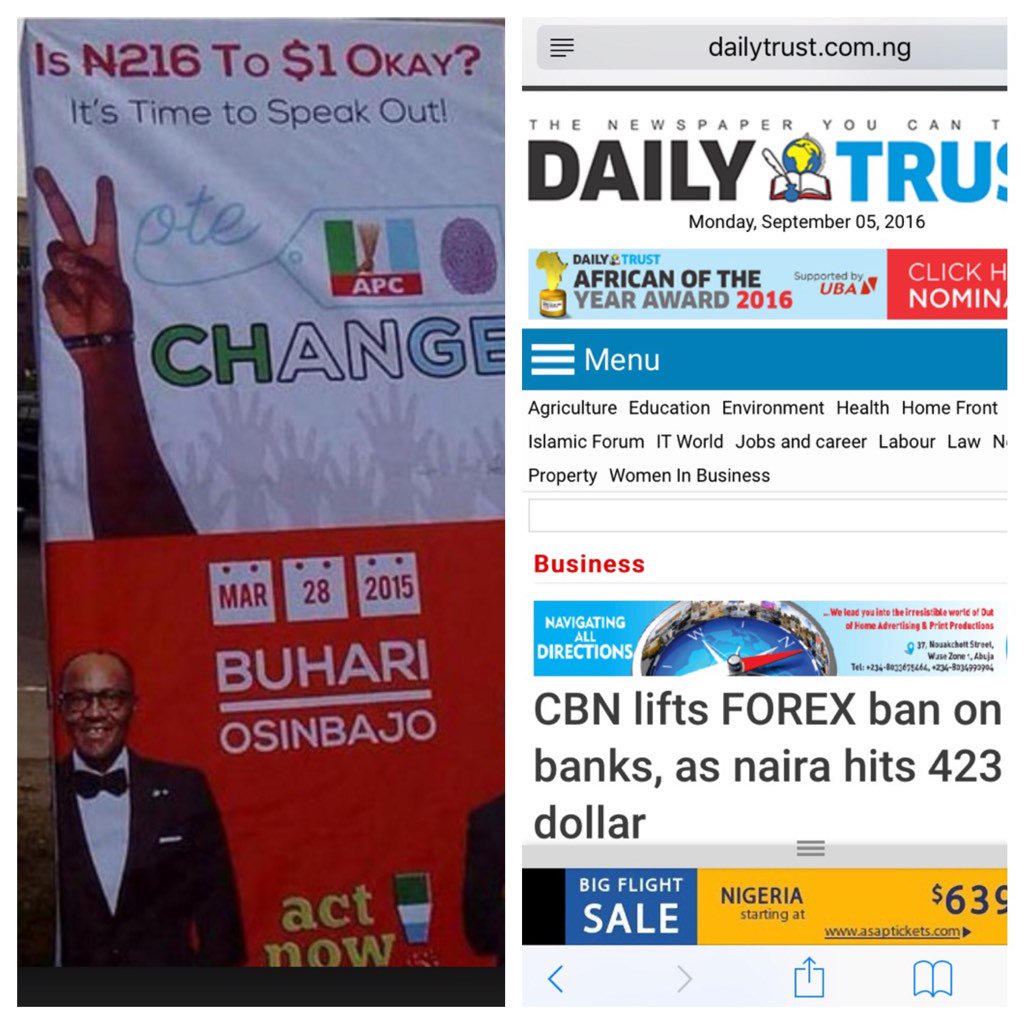
How did we get here? N500 is worth 5 Ghanaian Cedis now?

 
Jesus  Christ of Africa! how did we get here? someone please tell me that it is all a dream.

"The Mark Zuckerberg visit" By Reuben Abati


Facebook Founder Mark Zuckerberg visit to Nigeria has remained the much talk about visit on social media. Reuben Abati, one of Nigeria’s leading public affairs commentators and a media professional who served under the previous administration as a spokesman to the president, has given an in-depth analysis of the possible gains from Mark's visit to Nigeria.

 Read his article below:
 Mark Zuckerberg’s two-day visit to Nigeria has done a lot for the country; it is a pity no government official or agency has tried to tap into the gains of that visit. He arrived at a time there was much talk about economic recession, concerns about companies folding up or retrenching staff, or international investors leaving the country in droves, out of frustration with the uncertainties in the system. Zuckerberg’s arrival raised our hopes: co-founder of Facebook and the 5th richest man in the world, sneaked into Nigeria to meet with developers and entrepreneurs and to discuss investments in Nigeria’s growing start-up ecosystem. And for two days, he went round the city of Lagos, visiting start-ups and interacting with young entrepreneurs.
      The way Nigeria is often painted abroad, and in those travel advisories that foreign ministries issue, you would think Nigeria is such an unsafe place where kidnappers are permanently on the prowl. Zuckerberg helped to show the rest of the world that Nigeria is not so bad at all, and that something really exciting is happening here among the country’s young population. He had no bodyguards. He did not have to hire a lorry load of Nigerian policemen to keep watch over him. He trekked on the streets of Lagos, surrounded by a few of his hosts. On Wednesday morning, he jogged across the Ikoyi-Lekki bridge. He ate pounded yam, shrimps, snails (I thought they said he is a vegan!) and jollof rice (Nigerian jollof (!) not that one from Ghana). His visit went smoothly. More investors may well be encouraged to visit Nigeria too, seeing how confidently a whole $53.7 billion walked freely about in Nigeria, and he was not stolen or kidnapped.
          Zuckerberg’s visit also provided great publicity for Nigeria’s emerging Silicon Valley, and the young entrepreneurs to whom Zuckerberg paid compliments. He has already invested in a Nigerian start-up, Andela, and he has made friends with other young Nigerians, the guys behind Jobberman and C-Creation Hub (CcHUB) and so many others. Zuckerberg cut the picture throughout his visit of a true inspirational figure. His simplicity and humility was impressive. He kept going about in a T-shirt, and interacted freely with everyone he met.
     Many young Nigerians can learn from his example: the way some people whose biggest possession is a laptop sometimes carry their shoulders in the sky, if they were to be half of what Zuckerberg is, they won’t just claim that they are voltrons or overlords, they will look for more intimidating labels. But Mark Zuckerberg, who is just 32, shows that it is not all about money, or influence, character matters. There is no doubt that his hosts were also impressed with him.  And that probably explains the protest that greeted the attempt by CNN International and American artiste, Tyrese Gibson, to refer to the visit as Zuckerberg’s visit to sub-Saharan Africa. Young Nigerians kept shouting back that Zuckerberg is in Nigeria, not sub-Saharan Africa! They wanted the publicity for their country.
     Inspired by Zuckerberg’s visit as the tech entrepreneurs in Nigeria’s Silicon Valley may have been, the Nigerian government should see in the visit, and the excitement that it has generated, the need to provide greater support for technological innovation in the country. There are many young Nigerians out there who are gifted, hardworking and innovative. They belong to the 21st Century. They are aggressive. They want to operate at the international level and become superstars. They have ideas. They are ready and willing. The basic thing that government owes them is to provide an enabling environment for their talents to flower. It has taken a few young men and ladies to bring Mark Zuckerberg to Nigeria. There are other young Nigerians doing wonderful things in other sectors of the economy who can save this country if they are given the chance. There is also a large army of untapped and yet-to-be-discovered talents, whose future we cannot afford to waste. Investment in education will help. Uncommon sense will make things happen.
     Zuckerberg’s visit also did a lot for Nollywood. He described Nollywood as “a national treasure”. That statement should be framed and sent to every major agency in the private and public sectors in Nigeria. He may not yet have invested in Nollywood, but there was no doubt that the members of Nollywood and other celebrities who met with him appreciated their being recognized by one of the most successful young men of the 21st century. I watch Nollywood movies, but I don’t think I have ever seen those Nollywood stars who met with Zuckerberg smile that heartily and broadly - not even in the movies. The ones who did not bare their 32, were staring at the Facebook ambassador in that typical Nigerian fashion: “ah, see money, Mark, abi make I send you script make you sponsor?”
      The way the visit went, if Mark Zuckerberg had wanted a Nigerian wife, or girlfriend, he would have been met at every turn with echoes of “Yes, Yes, Yes…come and hold something.” But he is already married. So, don’t worry, Priscilla Chan (Mark’s wife), your husband is safe, Nigerian ladies will only admire him, they don’t mean any harm, and they won’t initiate him into coded runs.  But of course you trust him - you know he is not Justin Bieber. But money is good oh. After money, it is money. Ha, Ori lonise, eda ko la’ropin o, Edumare funmi ni money…
      Altogether, it was a great business outing for Zuckerberg and Facebook. Over 16 million Nigerians are on Facebook, it is the largest and most influential social media platform in the country; on a daily basis, over 7 million Nigerians log onto the website. Many more are on whatsapp, another Facebook acquired platform. With Zuckerberg’s visit, that number is bound to grow.  The strategic friendships and partnerships that he has been able to build is a demonstration of power and influence: Facebook is on the ground in Nigeria, the most populous country in Africa, and he has taken that further by visiting Kenya - look beyond the T-shirt, this young American billionaire is building constituencies and spheres of influence across Africa; he is exploring new markets and staying ahead of the competition in a continent that many other investors may overlook, or desert for reasons of inconvenience.
     As a business strategy, Mark Zuckerberg’s exploration of the African market is brilliant. It may be the subject someday of a Management, Leadership and Marketing Class. Businesses must innovate, innovate and innovate and the best way to do that is through people.  Nigerian entrepreneurs have a lot to learn in this regard: the mindset of the business leader is the soul of strategy. There are too many thermostatic leaders in the Nigerian business environment, and that is why at the slightest confrontation with hard choices, they close shop and run. Here is Mark Zuckerberg, in the face of proven recession, he wants to support start-ups and SMEs in Nigeria; at a time others are fleeing, he is coming into Nigeria and Africa. He is smart. Wicked problems in a business environment should inspire genius, change and innovation. That is what leadership is all about.
    Beyond business and culture, there was a small political side to the Zuckerberg visit. The Facebook CEO had said Facebook will promote the use of Hausa Language, some reports indicated he had said he loves Hausa language, and then a storm followed, resulting in a hot, healthy spat between two friends, colleagues and brothers of mine, Femi Fani-Kayode (@realFFK) and Reno Omokri (@renoomokri), with one claiming that Americans are promoting Northern hegemony (John Kerry, now Zuckerberg and Facebook), and the other saying it is not a big deal, and in the exchange, we got some lectures about Nigeria’s ethnic and hegemonic politics.
     On Wednesday at a town hall meeting, Zuckerberg more or less edited himself by saying “I am glad we support Hausa, and we are planning on supporting more languages soon.” He didn’t specify what those other languages are. I hope he knows Nigeria has over 400 languages and ethnic groups, and they all form part of the Nigerian Facebook community. He should tread carefully here, because I am not too sure Facebook can adopt Yoruba language before Igbo, or vice versa, without a social media war on its hands, and if Facebook chooses to accommodate the three major languages in Nigeria, it could be confronted with a major battle over minority rights on its platform. We are like that in this country, Mark.
     But the difference is that Mark Zuckerberg is not a politician, he has voted only once (in 2008) and he doesn’t make political statements, except when business interests are at stake. Eyin boys, FFK and Reno, Zuckerberg doesn’t really care about the local fights we fight: he wants to create new markets and if promoting Hausa on Facebook will create more customers in that part of Nigeria, so be it. And in case religion is part of that politics, it doesn’t concern him either, he was born Jewish, but he is a self-declared atheist. If he worships any religion, it is the religion of Facebook. In Nigeria, he has Igbos, Yorubas and other Nigerians working for him.
        He is interested in their intellect not where they come from.  One more thing: The Nigerian government snubbed him or did he snub our government? When he got to Kenya, he was received at the airport by the Cabinet Secretary of Information and Communications and later given a delicious lunch of fish, semo and soup, no Nigerian government official offered him common sachet water and yet he was here to create jobs and markets! We shouldn’t frighten him away with our politics! The good news, though, is that he is a humanist even if a secular humanist: End of story. Thank you Marky, for the visit and for giving us a good story to tell.